

Request for Paxton grant funds
Attached and embedded below is a request to utilize the remaining funds in the Paxton grant for campus sustainable landscapes which is now under the purview of ISEE. The persons on the CC are all familiar with some of the work in this area done over the past few years and can likely speak to the wisdom of using the funds to supplement the ongoing efforts.
TO: Dr. Evan DeLucia and Dr. Ben McCall
From: John C. Marlin
RE: Use of “Support for Sustainable Landscapes” funds
Date: March 21, 2016
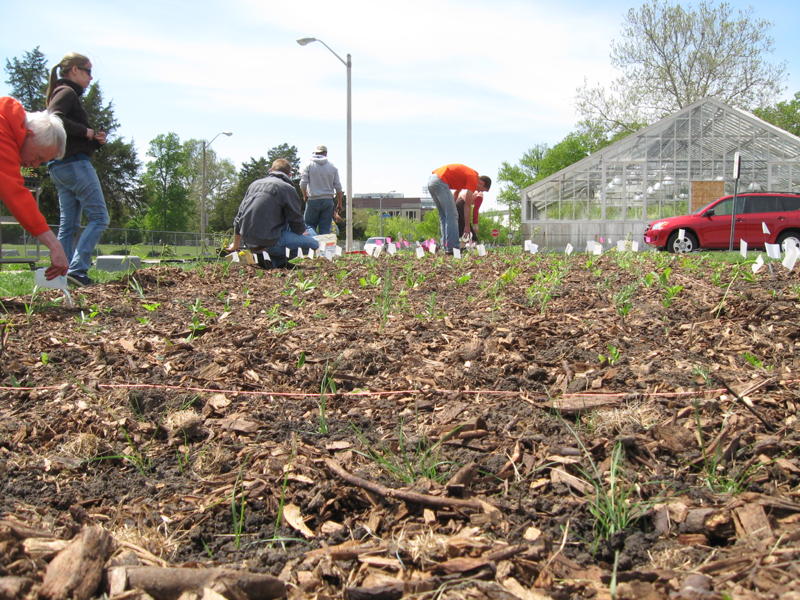
Several efforts are underway on the University of Illinois campus to promote the use and reestablishment of native plant species. The intent is to integrate native plants into the main campus landscaping and establish larger more diverse plantings in areas farther from the main campus in conjunction with the removal of invasive plants such as bush honeysuckle. The plantings will be especially valuable to insect pollinators and birds and will provide significant educational opportunities. To date much of the funding has come from the Student Sustainability Committee.
Work at the moment is concentrated on the 2.3 acre prairie at Florida and Orchard in Urbana, the wooded area at the southern end of the Arboretum known as SAW (South Arboretum Woods) including the Pollinatarium, and the Forestry Plantation along Race Street. Other active sites include Burrill Hall, the Natural Resources Building, and the Florida Orchard Prairie. Another small project is about to begin at Lincoln Avenue Residence Hall, which will be largely supported by LAR funds and student volunteers.
In addition to the SSC, several campus and community groups have made substantial contributions to the effort primarily through volunteer labor. The Master Naturalists and Grand Prairie Friends have provided hundreds of volunteer hours as have local citizens who attend work days. Individual students, faculty, and staff as well as Red Bison, Students for Environmental Concerns, and other student service organizations put in additional hours.
NRES purchased a $30,000 chipper and hired a contractor to remove honeysuckle with a forestry mower at the forestry plantation. The machine was also used on a limited basis at the Arboretum. Additional staff and in kind support was provided by the Arboretum, Pollinatarium, Prairie Research Institute, and Illinois Natural History Survey.
Recent SSC funding received by the Arboretum makes it possible for the forestry mower to return and remove large stands of honeysuckle. Workers will then remove by hand the honeysuckle too close to trees for the machine to cut. The area will then be replanted with native understory species as the invasive plants are brought under control. This will take several years. Various research projects focused on native plantings and their usefulness to other species are also envisioned.
Considerable additional funding beyond that provided by SSC is required to complete this effort. It is anticipated that the Arboretum and others will seek grants for future work and research. It is, therefore, requested that the remaining funds in the $10,000 donation “Support for Sustainable Landscapes” Dr. Jack Paxton made several years ago be made available to further this work. The funds would be used to supplement and match SSC and other funding. Specifically the funds would be available for the following purposes as needed: supplies and equipment, removal of invasive plants by contractors or hourly workers in campus areas, and purchase and planting of native plant material at appropriate campus locations.
Dr. John C. Marlin, a research affiliate at ISTC and INHS and Adjunct Professor in NRES, has lead much of this effort since 2011 as a volunteer. He continues to coordinate considerable activity by students, staff and community volunteers on these projects. He is also available to coordinate the proposed project.
Primary collaborators include Dr. Marlin; Arboretum Director, Dr. Kevin McSweeney; and Jay Hayek the Extension Forester within NRES.
This use of the Paxton grant is supported by Dr. Paxton (who has contributed numerous volunteer hours) and campus Facilities and Services. If a committee is needed to consider this matter, the SWAT team that deals with land and agriculture could probably be involved.
If there are any questions or a need for discussion, please contact Dr. Marlin at marlin@illinois.edu 217-649-4591
CC:
Dr. Jack Paxton
Brent Lewis
Morgan Johnston
Jay Hayek
Dr. Kevin McSweeney
Micah Kenfield
John C. Marlin PhD.
Research Affiliate
Illinois Sustainable Technology Center and
Adjunct Professor
Department of Natural Resources and Environmental Sciences
University of Illinois
One Hazelwood Dr.
Champaign, IL 61820
217-333-8956