


You are here
Thermochemical Batteries: Turning Waste Heat into an Energy Source (In Progress)
Recent Project Updates
No project updates found
Project Family
-
iSEE Campus as a Living Lab (CALL) Projects
- Adaptive Aluminum Tensegrity Structure as a Bike Parking Canopy
- Addressing Community Health Disparities from Hazardous Waste
- Agrivoltaics: Crop Production and Solar Panels on the Same Land
- City Traffic as a Reservoir System
- Creating Adaptable Autonomous Systems for Energy-Efficient Buildings
- Environment-Enhancing Food, Energy, and Water Systems
- Faculty/Staff Crowdsourced Community Program
- Geothermal: Thermo-Hydraulic Properties of Glacial Tills
- I-PLACES Living Laboratory
- Integrating Groundwater Resources and Geothermal Energy for Water-Energy Security and Resilience
- Student Mobility on and around the Illinois campus
- Testing Geopolymer Performance in a Geothermal Exchange System
- Thermochemical Batteries: Turning Waste Heat into an Energy Source
- Towards Zero Waste: Automated Waste Classification via Computer Vision
- Wind Turbine/Pavilion Integration for Electricity Generation
Associated Collections
Description
In everyday life, we think of heat as a measure of temperature. To engineers, however, heat is actually a signal of energy transfer — the “heat” you feel is energy being transferred from a warmer thing to a cooler one.
To harness heat energy currently going to waste (just being exhausted into the air) from industrial sources for other purposes like space heating, Illinois researchers from the Department of Mechanical Science and Engineering and the Illinois Sustainable Technology Center (ISTC) will create a battery pack capable of storing heat through a series of chemical reactions in the project seed-funded in Spring 2018.
Purpose of the Work: Campus Connection
The key motivation for the concept is to overcome the outstanding issues with thermal (heat) storage: lack of long-term storage, low energy density, expensive systems and inflexibility of upward/downward scalability in designs.
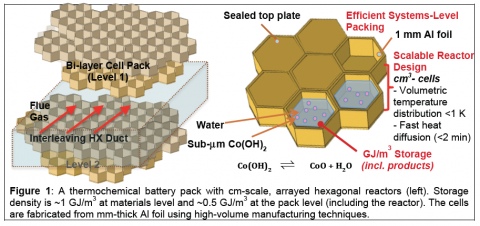
The initial designs of this project — seed-funded by iSEE in 2018 — look like stackable honeycombs filled with chemical soup that will soak up and store energy from exhaust heat. In the seed-funded phase of the project, graduate student researchers will study the repeatability of charging and discharging energy in the thermochemical battery, keeping detailed notes on how well the battery holds the power and if and when energy leaks occur. This proof-of-concept will be invaluable for refining the system — and for writing proposals for additional funding.
The proposed storage system for Abbott Power Plant on campus needs to be designed for multiple scenarios, several of which arise in power plants. Abbott has multiple waste heat loss points that could benefit from thermal storage. The team will acquire and understand the existing waste heat loss data in terms of heat source temperatures, loss quantity, transients, and fluid flow rates associated with the losses. They will use the data to identify the components suited for thermal storage systems and explore designs that match the conditions at Abbott.
Broadly, space heating is a large part of the campus’ energy use. In the long term, thermal storage offers the possibility of unique improvements in efficient use and reduced costs for the entire campus.
Project Team
-
Team Members:
- Sanjiv Sinha, Professor of Mechanical Science and Engineering
- Placid Ferreira, Professor of Mechanical Science and Engineering
- Nenad Miljkovic, Assistant Professor of Mechanical Science and Engineering
- Kishore Rajagopalan, Associate Director for Applied Research, ISTC
Themes
-
Primary Theme: