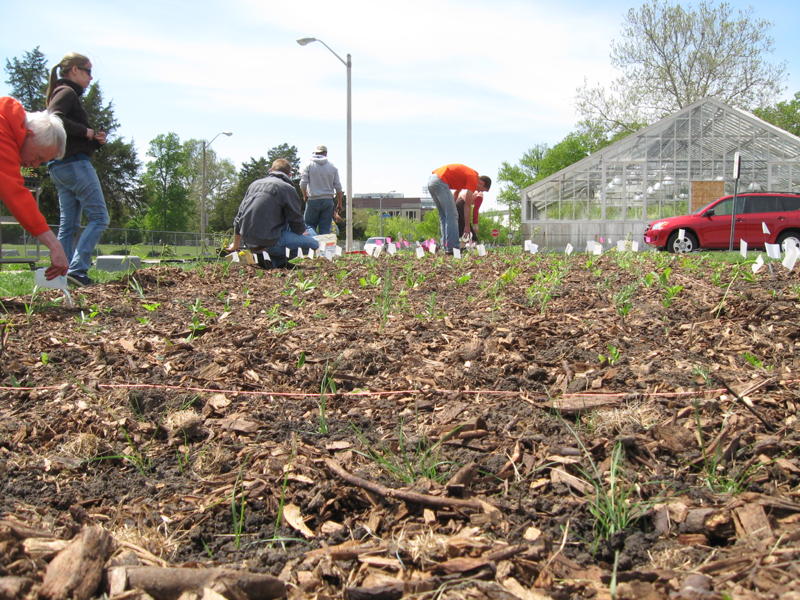
Olivia Harris with the Green Observer interviewed Morgan Johnston about the Zero Waste plans for campus. She had spoken already with Marcus Ricci and Seth Rients. She was doing a class article, then revising it for the Green Observer.
My name is Max Colon, and I am a Resident Advisor in Allen Hall that works with a sustainability group to try and keep Allen green. Every year, we hold a recycling box drive where our organization hands out cardboard recycling boxes that have been given to us by Housing. I have a attached a photo of one of these boxes for identification purposes. I am wondering if it is possible for you to help me figure out who in Housing should be contacted in order to continue this tradition. Any information you could provide would be greatly appreciated! - Max
We had the boxes over 10 years and we have depleted all supplies last year. Sorry- Vonne Ortiz
The saw dust pan at the PPSB is no longer emptied at the WTS. We are currently emptying it at the Horse and Dairy barns. It is now being diverted from the landfill. Also, the DSC staff that work here at the WTS work hours has been extended to 3:30PM provided we have work for them here to do. This way all the pans with the exception of the compactors from Dining Services and the trash from ORD will be emptied in the south bay here at the WTS.
Applications are now being accepted for a new Bicycle Ambassador program at the University of Illinois. Bicycle Ambassadors are bicycling enthusiasts who will promote bicycling for transportation, raise awareness about the rights and responsbilities of cyclists, and foster a postitive bicycle culture on our campus. Interested students, staff, and faculty are encouraged to sign up to become a Bicycle Ambassador today!
The Sustainability Fellows program was going to include a research fellowship for Professor Gale Fulton to create a stormwater master plan for campus, utilizing green infrastructure. Unfortunately, Professor Fulton took a job at another university. To move forward with the stormwater master plan, the F&S Environmental Compliance department will seek to create a stormwater master plan for campus using student assistants and in-house staff.
Since we want to put the energy displays around campus, Madhu Viswanathan can help us identify the best method for implementing these to change behavior.
We need to determine how many displays to install, where they should go, what information should be on them.
How can we use this system that F&S now has through your office to actually improve energy use behavior.
We would like building users to become more conscious of the energy use in their building(s).
What sort of display and style will really grab their attention?
Is social media something that we should utilize for this effort?
Dave Thomas, Kishore Rajagopalan, and Luis Rodriguez hosted a meeting with Morgan Johnston,Tracy Osby,and ISTC staff to meet with Orval Yarger and Alan Robinson from Paradigm to discuss opportunities for waste management for campus and other Illinois businesses/organizations.
F&S Engineers provide input on solar film technology: "We experienced delamination with these in the past; about 25 years ago. I’d be curious if the adhesives have gotten any better." - John Prince
"Films have come a long way. Like John, I have seen several versions of solar films and have not been impressed with their durability. The newer films and coatings are much better but the effectiveness is still dependent to the quality of installation. The films may have some applications on campus but must be evaluated in terms of cost. The solar transmittance is low enough for me to question whether IHPA would have a problem with our historic buildings. We would also want to avoid a checker board appearance if the product were applied randomly to a building windows. I don’t want to dismiss the product but it does need more investigation." - Fred Hahn
A new Academic Hourly Position, Campus Bicycle Coordinator, has been created within the Facilities & Services division. Amelia Neptune, formerly a Sustainability Specialist in F&S was appointed to the position for the 2014 Fiscal Year (July 1, 2013-June 30, 2014). The Campus Bicycle Coordinator will report to the Sustainability Coordinator within F&S, under the Engineering & Transportation Services department. The Campus Bicycle Coordinator will be responsible for promoting bicycles and bicycle education, enforcement, encouragement, engineering, and evaluation and planning.
Tom Abram was the Sustainability Coordinator at F&S when the ACUPCC was signed and the Climate Action Plan was written. He prepared this vision for funding sustainability efforts on campus in 2008.
Facilities & Services is taking an interim step to make some initial improvements during spring and summer 2013. This work includes repainting several existing dedicated bike off-road and side paths, and adding stop signs for bicycle traffic at key intersections on existing paths. This step does not bring the existing bikeways up to acceptable safety standards, yet they will reduce bicyclist / pedestrian conflicts.