This form will search for words in the title OR the description. If you would like to search for the same term(s) across both the title and description, enter the same search term(s) in both fields.
This form will search for any of the words you enter in a field, not the exact phrase you enter. If you would like to search for an exact phrase, put double quotes (") around the phrase. For example, if you search for Bike Path you will get results containing either the word BikeOR the word Path, but if you search for "Bike Path" you will get results containing the exact phrase Bike Path.
On 6/8/2021, the Student Sustainability Committee released a semesterly report on the Bicycle Registration and RFID Tracking Program. The report is attached.
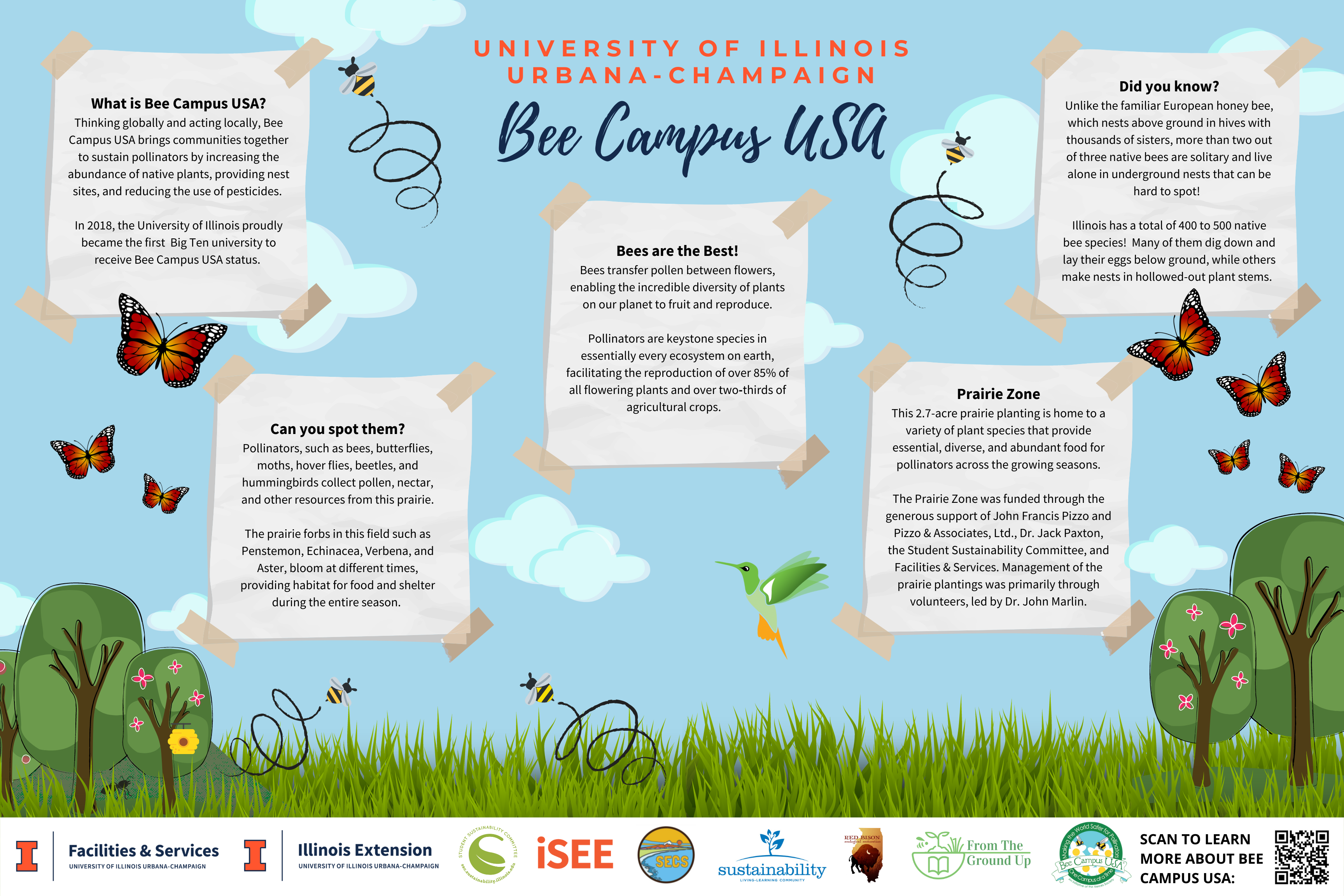
A 24" by 36" Bee Campus USA sign will be installed at the corner of Florida Avenue and Orchard Street, by the Florida-Orchard prairie, near Orchard Downs and the Presidents’ House.
The sign includes information about Bee Campus USA, local pollinators, the creation of the prairie zone, and more!
See the attached file to view a digital rendition of the signage.
This funding allowed for the removal of outdated fixtures, upgraded lighting fixtures to LED, and decreased the per fixture energy consumption while increasing the overall light levels to an acceptable workspace benefiting the University users.
All, We’re getting legitimately busy nowadays! We’ll be keeping an eye on overall capacity and having to limit some visitors soon.
I’m scrambling to finish more bikes to capitalize on the surging demand but we’ll likely sell out this week or next.
Over the weekend we’ve gotten over 50 bike registration notifications so it’s likely we’ll see an uptick in registration pick-ups here.
We had a patron come in on Friday who’s an RA at LAR and took all of our rack card flyers to hand out to his students—hopefully that’ll bump up our applications.
The numbers:
Visitors: 41 Sales: $1,362.60 Bikes (refurb): 6 for $940 Memberships: 6 for $180 Tires/tubes: 8 for $42 U-locks: 6 or $126
In the 2021 Freezer Challenge, 222 labs participated from over 100 different research institutions across 17 countries. The combined efforts of the scientists and labs saved 4.6 million kWh of electricity over the past year, which is the equivalent of reducing carbon emissions by 3,260 metric tons.
Based on the U of I's submitted scoresheets (33 in total), the combined actions of the university saved a total of 1051 kWh/day across multiple labs throughout campus.
All, This update is a day late as I was out of the office on Monday. Last week I was out on Thursday and Friday as well. Student staff covered Bike Center hours in my absence. On Monday last week we received a bike from Housing which we were able to quickly fix up and put out for sale. This week we have a couple drop off repairs to catch up on, a few more bikes to fix up for sale, and some donations to process.
The numbers:
Visitors: 26 Sales: $1,167
Memberships: 6 for $180 Bikes (refurb): 3 for $500 U-locks: 5 for $105
Please see attached the final bicycle registration sign design in JPEG and PDF formats. We have received approvals from Housing to put up these signs in the major high traffic bicycle parking locations, mainly in the SDRP, LAR, FAR/PAR, and Busey Evans bicycle parking areas. We are also looking at Illini Union and ARC for these signs in this cycle, but dependent on funding.
Sarthak Prasad has submitted a work order to fabricate and install the bike registration signs at these locations (as mentioned in previous project updates). The Work Order number is 10885468.
Dump and Run is BACK! After a 1-year hiatus, the University YMCA is thrilled to once again hold community collections and the Big Sale this August. All collections and the sale will be held at the U of I Stock Pavilion, in cooperation with the College of ACES and Dept. of Animal Sciences.
Dump and Run keeps over 30 tons of used, quality goods out of Champaign-Urbana’s dumpsters and landfills each year. This project reduces litter and consumer waste, saves space in landfills, lowers dumping costs for certified housing and apartments and provides inexpensive items for folks to purchase in the fall.
While we were unable to hold our normal spring collections this past May, we look forward to collecting as many great items as we can from our community and hope that you will join us in helping find usable goods a new home. Thanks to the community and the University of Illinois for making Dump & Run a success each year, and we will see you this August!
Community gardens built on the farmlands at Orchard Downs are available to use for growing their own food. They are managed by volunteers who assign and take payment for plots for the Family Housing Council. Housing pays for the water via funds that are collected, and they manage the plowing, clean-up, and maintenance of the garden area. Gardeners range from University administrators and students to community members. This program has been active since at least the 1990s.
From: Maloto, Avery (FandS) <fandsamaloto2 at mx.uillinois.edu> Sent: Monday, July 19, 2021 1:15 PM To: Johnson, Bryan Lloyd <blj at illinois.edu> Cc: White, Morgan <mbwhite at illinois.edu> Subject: [Follow-Up] iCAP Portal Update(s)
Hi Bryan!
I would like to offer a gentle reminder for the iCAP Portal content updates. We would appreciate receiving this information as soon as possible as it allows us to keep the public updated with university & community initiatives.
Right now, I am missing updates for the following project(s):
Food Purchases from Local Sources
Orchard Downs Community Gardens
SDRP Lighting
Please let me know if there is any information or assistance that I can provide to complete these!
On August 2, 2021, SSC approved the scope change for the Bike and Ped Counters project as requested on July 21, 2021. Sarthak Prasad will make a purchase request to procure a new set of Eco-Counter bicycle and pedestrian counters.
All, Busy week! Sold bikes, stripped bikes, helped people fix bikes. We had especially good volunteer turnout on Friday. One frequent visitor even donated his neighbor’s old bike that was headed for the dumpster before he intercepted. Another person said they’ll be here to volunteer on Monday.
Donations, thankfully, have hit a little bit of a lull, so we’ll be able to spend this week catching up on that. On Friday alone—see aforementioned volunteer levels—we started 4 new shop builds that will be finished this week.
We also sold a bike to someone from Housing who works specifically in promoting healthy and environmental lifestyles in the dorms. He seemed really jazzed about our programming and operations. Hopefully that’ll be a future partnership.
The numbers:
Visitors: 28 Sales: $1,307.10 Memberships: 2 for $60 Bikes (refurb): 6 for $1,040 Tires/tubes: 5 for $26 U locks: 3 for $63
Thank you to those who participated in the Geothermal Illinois webinar on 7/29! Many thanks to our presenters, Dr. Tugce Baser, Assistant Professor, Department of Civil Engineering, University of Illinois Urbana-Champaign; John Freitag, Executive Director, Geothermal Alliance of Illinois; and Dr. Yu-Feng Forrest Lin, Director of Illinois Water Resources Center; Principal Research Hydrogeologist, Prairie Research Institute.
Please join us on August 10 and August 12 for geothermal webinars that will give us a closer look at campus projects and community models.
For more information, please contact:
Nancy Esarey Ouedraogo Extension State Specialist, Community and Economic Development UNIVERSITY OF ILLINOIS EXTENSION https://extension.illinois.edu/ 905 S Goodwin Ave 557 Bevier Hall MC 184 Urbana, IL 61801 esarey@illinois.edu 217-244-7020
“Chuck: You mentioned recently the patio had some weeds that needed to be cleaned up. I took these photos today. The areas in the photo are student garden areas. I did see someone in one of the garden areas southeast of LAR last week. I am not clear if she was there to work in the garden or perhaps for other research work.
John: Would you be able to assist (organize some student help perhaps) with weeding in the patio gardens? Could you also include the student garden plantings at the main east entry to the building as well as the smaller gardens each side of the drive at Lincoln Ave.? These are the first areas people will encounter at move in.”
-Wayne Bugaj (07/27/2021)
“Hello All,
Yesterday I did some cleanup along with Sara Mason, a former LAR LLC member who graduated last year. We pulled weeds by the small beds near the wheelchair ramp and did some trimming in the front beds including the one near Lincoln Ave. Two other former LLC students from 2016 and 17 helped a couple times this summer with some very basic weeding. The people who started this maintain an interest, but most have let town. The virus and “student priorities” have kept the regular LLC students from doing anything in the plantings for about 2 seasons. Hopefully that will change this year. Basically the plantings are mostly doing well. They need some weeding and thinning. A couple spots on the S side of the front steps and SW side of the building have areas where one or two species have taken over. Some replanting would probably be good there, but is not critical.
The main goal of providing pollinator resources is definitely being met.
Chris Murphy told me in the spring that he hoped to get a faculty member to oversee a few students who could get credit for maintaining the plantings.
Anyway things look better now. We took out 2.5 35 gallon cans of weeds.
YOU are invited to iSEE's monthly TED Talk: Eco-Edition series discussion. Tomorrow (Tuesday), July 27 at 5:30 PM, Paul Foote, F&S Energy Efficiency and Conservation Specialist, will host the event and lead the July discussion on energy conservation. We will view a pre-recorded TED Talk , "The four things you need to know about the energy you use", followed by a guided discussion and roundtable. All are welcome to this (fun!) Zoom event, and I hope to see you there! Register here.
A student research team, under Dr. Yuanhui Zhang, will expand the Environment-Enhancing Energy (E2E) research program to campus application by augmenting wet food waste produced through the dining halls. They will first survey dining services food waste and make their findings available to campus affiliates. Next, they will take dining waste and convert it into biofuel and asphalt. This process will reduce UIUC’s food waste, advancing the Illinois Climate Action Plan efforts. Likewise, the project will bring awareness to food waste at a local level. In December 2017, this project received $10,000 from the Student Sustainability Committee to kickstart the project.