CHAMPAIGN, IL (October 22, 2014) – Eight facilities on the Urbana campus will win funding for facility improvements as recipients of the 2014 Energy Conservation Incentive Program (ECIP) awards on Wednesday, October 22 at 3:00 p.m. in Illini Union 314B as a part of the Illinois Climate Action Plan (iCAP) Forum.
Last year, the ECIP awarded more than $250K in pre-approved energy conservation projects.
Tawab Hlimi is serving as faculty advisor for the 2014 EPA Campus Rainworks Challenge. The team is composed of graduate students from Landscape Architecture, Architecture, Civil Engineering, Environmental Economics, and Ecology. They have begun a green stormwater infrastructure study for the UIUC campus and have selected the channelized extent of Boneyard Creek as site for a demonstration project.
It is time to evaluate — and update — the Illinois Climate Action Plan, our campus sustainability roadmap. The campus and local community is invited to join iSEE on Sustainability Day, Oct. 22, for an iCAP Forum from 1 to 4 p.m. in Illini Union Room 314B. You'll get updates on progress toward 2010 goals and hear about and discuss proposed revisions for the 2015 version. RSVP: http://bit.ly/1BIPn4K
Attached please find a reply from the iCAP Working Group regarding the wind PPA process.
By the way, thanks so much for your participation in iSEE's Roundtable this week...sorry we didn't get a chance to chat!
Cheers,
Ben
--
Professor Benjamin J. McCall
Associate Director for Campus Sustainability Institute for Sustainability, Energy, and Environment University of Illinois at Urbana-Champaign campus-sustainability@illinois.edu
Objective 3.1 is for the SWATeam to lead an exploration of options for 100% clean energy and submit recommendations. F&S staff workload is too high to handle the exploration of options, so F&S will provide data and provide comments. Ben McCall and Scott Willenbrock will develop a plan for how to achieve carbon neutrality. They will make a document with potential options, pros, cons, and costs.
Illinois Sustainable Technology Center (ISTC) Water Audit Webinar – Oct. 21 at 11 a.m. – 12:15 p.m. (web only)
“Water Use and Conservation on Illinois College Campuses: The Ripple Effect”
The Illinois Green Economy Network (IGEN) and the Illinois Sustainable Technology Center (ISTC) are partnering to train college faculty and staff to conduct water audits on their campuses, increasing knowledge about water on college campuses, and furthering ISTC’s goal of reducing water consumption in Illinois by One Billion Gallons. To do so, IGEN and ISTC will implement a three-phase program. In the first phase of the program, IGEN will cohost a webinar with ISTC to educate interested colleges on the basics of water audits. The webinar will cover the following information:
Details of what a comprehensive water audit encompasses: the built environment, the campus landscaping, and the local topography/watershed;
Where to find specific information on water use on a college campus: what bills, what departments have information, what is metered, etc.;
Potential benefits of water audits: how to save money, water, and energy, and the environmental impacts; and
Overview of the next phases of the program and how to participate.
Speakers will be: Megan Chery, Manager of Alliance for Water Efficiency; Aaron Dunbaugh, Director of Sustainability at Loyola University Chicago; and Michelle Maddaus, Founder and Civil Engineer with Maddaus Waste Management.
In the second phase of the program, IGEN and ISTC will arrange regional training sessions at several Illinois community colleges to train stakeholders on how to conduct a comprehensive water audit on campus. In the third phase of the program, colleges will conduct water audits on their campuses and make recommendations that will reduce water consumption and apply for grants to implement the projects.
ISTC is a division of the Prairie Research Institute at the University of Illinois at Urbana-Champaign.
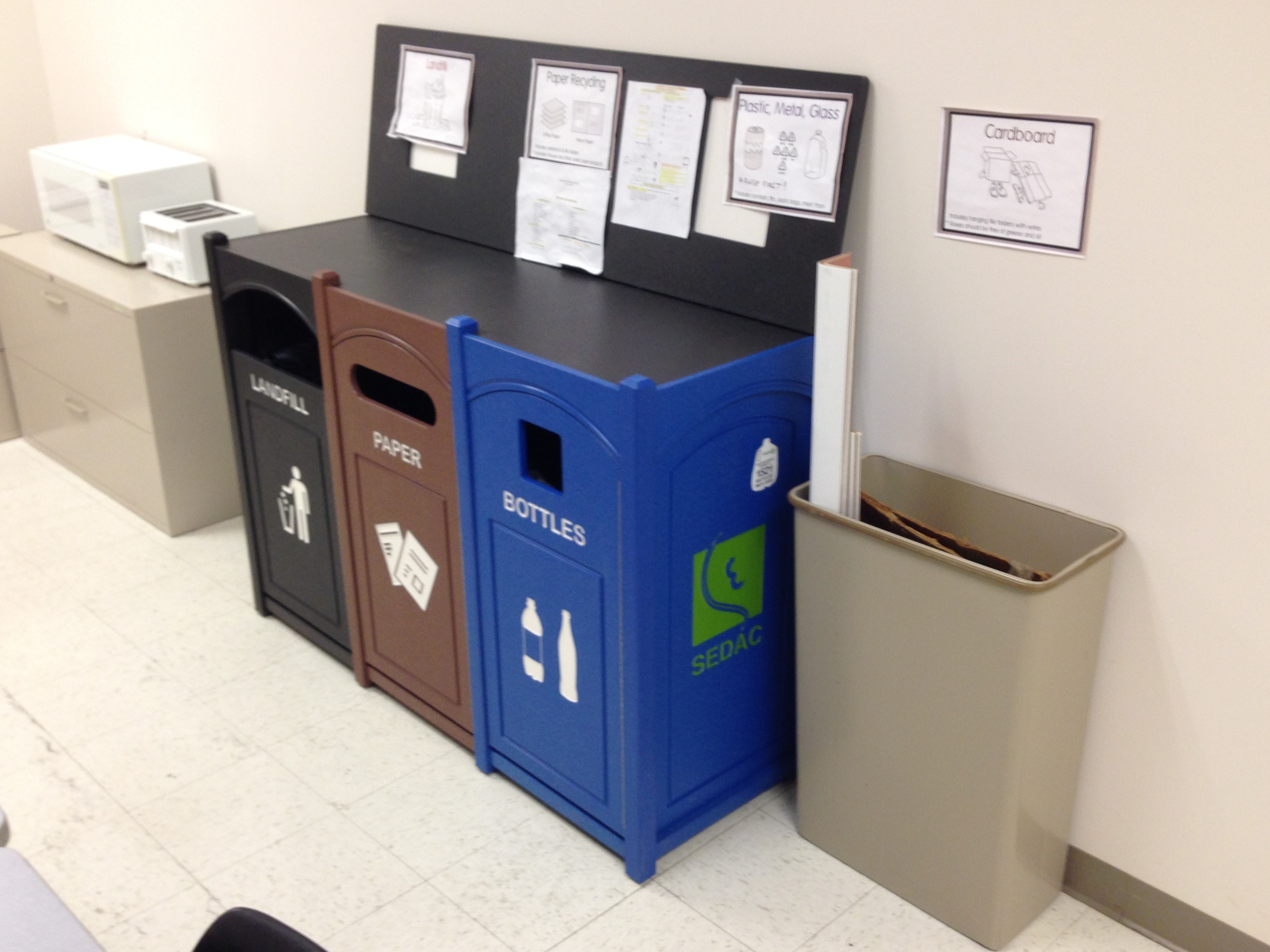
Courtesy of Max-R (big name in recycling bins), we have a new, functional, clean, state-of-the-art rubbish/recycling station in the break room (photo attached). It will still be serviced by our same cleaning staff. As free time allows, I’ll update the signage. The cardboard bin is next to the pretty bin. Note the SEDAC logo and the “this is made from 1501 recycled milk jugs” image.
Thanx to Lucas, Stevie, Carrie, Aaron and others for logistical and physical support in getting it sited.
From: Lage, Stephanie M Sent: Friday, September 26, 2014 2:50 PM To: Bender, Karen L; Vanhoy, Roger; Fruehling, Amy; Goodlad, Lauren M E; Hodson, Piper; Chakraborty, Arnab; Johnston, Morgan B; Ben McCall Cc: Kokini, Jenny; Rosenbery, Amy Nichole; Mancuso, Anthony D; Khanna, Madhu Subject: Roundtable October 7
Good afternoon,
We are finalizing some details for the Roundtable Discussion on Tuesday, October 7, 2014.
As you can see on the attached agenda, the event begins at 9:30 and will be finished up by 4:00.
We have 12 visitors coming from corporations, government and non-government agencies. We hope that you will take advantage of this opportunity to interact with them and stay for the whole day, particularly for the roundtable discussion, and the small group discussion.
Please confirm your attendance for lunch and the afternoon discussions so that we can finalize lunch counts and appropriate seating arrangements.
Thanks!
Stephanie
Stephanie M. Lage
Assistant Director
Institute for Sustainability, Energy, and Environment
This letter is in response to the Illinois Climate Action Plan (iCAP) Working Group (iWG) recommendation #EG001, which Facilities & Services (F&S) received on August 28. F&S agrees that the campus should investigate the feasibility of entering into a Wind Power Purchase Agreement (PPA) to increase the use of renewable energy for campus.
Regarding the EG001 general statements about campus energy use, data points, and assessments of anticipated financial impacts, F&S will need more time to compile a useful response. Regarding the three specific EG001 recommendations, I have consulted with Al Stratman, Kent Reifsteck, and Mike Larson to provide the responses below.
Recommendation: “The campus should undertake a Power Purchase Agreement for wind energy. Based on currently available information, we recommend that the amount be at least 119 million kWh per year (25% of our total electrical usage), but we should aim to purchase as much as we possibly can, given any technical, financial, and contractual constraints.”
From this recommendation, we understand that the iWG recommends entering into a Wind PPA for at least 25% of the FY15 electrical demand. However, the campus cannot make an informed decision about whether or not to undertake a PPA until the financial impact is fully understood. A key component of the financial impact is the fully burdened cost of the purchased wind power, which will not be known until after the successful completion of the Request for Proposal (RFP) process. Therefore, F&S does support pursuing a PPA so the feasibility can be evaluated, but we do not support making a final decision to undertake a PPA until completely evaluating the financial implications.
Recommendation: “The effort to secure a PPA should be pursued as quickly as possible. The campus should inform PEI that this is a top priority, and that the review of RFI submittals and the issuance of the RFP should be expedited by all necessary means.”
During this summer, F&S worked with PEI to define a schedule for issuing a Request for Information (RFI) and a subsequent Request for Proposals (RFP). This schedule shows a completion date of April 2015, so that the PPA could commence with delivery of power on July 1, 2015, at the start of FY16. We have informed PEI that this is a top priority, along with safety and reliability of the overall campus energy system.
Recommendation: “The iCAP Working Group should be kept informed and advised during the process of pursuing the RFI, RFP, and PPA, and given the opportunity to provide recommendations before key decisions are made about the PPA, to ensure that technical and financial considerations are appropriately balanced with our campus sustainability objectives.”
F&S values the advice and input from sustainability advocates on campus. Therefore, we suggest developing a set of interim checkpoints for keeping the iWG informed as the process unfolds.
To meet our Climate Commitment and achieve carbon neutrality, there is a lot of work that needs to be done. I look forward to working with the iWG and the SWATeams as this recommendation is pursued.
UO does cool things when it comes to the material management system. They did one of the first campus waste audits back in the early 90s and have since grown into a power house in recycling and materials management. They have a new training video. Its 50mins long, and yes that is extremely excessive. But it is a great cheat sheet to evaluate our current state and where we could go.
Shantanu Pai
On Thursday, September 11, 2014 11:28:32 AM UTC-5, K2 wrote:
Here is a training video that the students just finished here at the University of Oregon. It’s close to an hour and will be shown to all new student employees with the UO Zero Waste Program. It’s funny and poignant while being instructive. Way to go students of the world…..working so hard for a better life…..it’s crazy to see how hard we all work saving resources. This video is about you too…..and we say to all of you in zero waste land-THANKS for recycling! Zero Waste is Higher Education….
From: Miller, Kristina Ruth Sent: Friday, September 12, 2014 8:43 AM To: Lage, Stephanie M Cc: Strater, Darren; Alexander, Franklin S Subject: RE: Air Travel dollars
Hi Stephanie,
Darren Strater asked me to provide you with the information you requested.
For FY14 Airfare for Chart 1 (UIUC) totaled $14,014,590. This included extra charges for baggage fees, changed ticket fees and booking charges.
With JUST the price of the Airfare ticket, the total for Chart 1 (UIUS) totaled $13,671,434.
If you need a formal breakdown, please let me know.
To get air travel emissions, miles must be entered into the Clean Air-Cool Planet calculator.
Mileage data is not tracked for our campus. So, I request air travel dollar data from OBFS. This number has become more reliable in recent years because of the T-card implementation.
Air travel dollars are converted into miles using the passenger yield (fares per mile) data from Airlines for America.
In fy 2013, dollars spent on air travel was $9,283,105.82. Passenger yield was $0.1514 (this is fy 12, apparently fy 13 was not yet available).
Morgan, here’s the direct link to the resource I mentioned to you on the Great Lakes Regional Pollution Prevention Roundtable (GLRPPR) web site. The GLRPPR site is pretty extensive, with many “sector resources,” so I’ll save you the trouble of navigating through them.
I don’t know if you were specifically interested in water-related calculators, or if you were using that as a hypothetical example. In any event, there are a few water-related calculators within the list at the above URL. US EPA’s WaterSense program provides a calculator for residential savings, if you replace existing fixtures with WaterSense labelled items. Seehttp://www.epa.gov/watersense/our_water/start_saving.html#tabs-3. This could be a resource to provide students or staff who ask you about such calculators, but be mindful (as you should with any “canned” calculator) of the assumptions made regarding things like utility costs, average number of gallons of water used per year, etc. (http://www.epa.gov/watersense/our_water/how_works.html#assumptions). This particular tool wouldn’t be useful for campus buildings; the Alliance for Water Efficiency provides some guidelines for calculations on school and university campuses:http://www.allianceforwaterefficiency.org/Schools_and_Universities.aspx.
The University of Illinois at Urbana-Champaign is pursuing development of a large-scale food waste composting facility on the University’s property, in order to compost food waste from University dining halls. This interest is precipitated by the commitment made by the University in the 2010 Illinois Climate Action Plan (iCAP): “The University will commit to… a large‐scale food composting project by 2012.” The new facility will initially receive and process all acceptable pre- and post-consumer food waste from six dining halls on campus, as well as supplementary landscape waste as necessary carbon bulking material from Campus Grounds. In the future, if needed, the system may accept additional landscape waste from the city of Champaign as well as livestock bedding and other animal-related organic waste from the University’s Agricultural and Animal Sciences Departments. The finished product will provide rich compost material to agricultural projects on campus such as the Sustainable Student Farm, as well as to campus grounds and athletic fields.
Background
The University of Illinois is dedicated to composting across the board. There are three main academic campuses at Urbana, Springfield, and Chicago and two medical campuses at Peoria and Rockford. We are in communication with all of these sites about the future of composting at the University. This is an exciting opportunity for the sustainability contacts to work together and support each other in a major sustainability initiative. Additionally, the University Extension office has a long history of supporting sustainability and has numerous resources for composting operations that we can call upon as the project progresses.
In 2008, the Chancellor of the University of Illinois at Urbana-Champaign signed the American College and University Presidents’ Climate Commitment, pledging to become carbon neutral by the year 2050. As part of this commitment, the University published “Illinois: A Climate Action Plan (iCAP)” in May 2010, describing several projects related to various aspects of campus sustainability. This document is available online at http://sustainability.illinois.edu/iCAP.html.
The Procurement and Waste aspects of campus sustainability are highlighted on page five of the iCAP. It states “The University will commit to a Zero Waste campus policy by 2012, a large-scale food composting project by 2012, and target an increase in the University’s waste diversion rate to 75 percent by 2020.” The specific project is listed on page 34 item 4 under Agricultural targets, as “Incorporate a large-scale food composting project by 2012.”
The composting project also has significant support from campus leadership represented by Associate Chancellor Pradeep Khanna, Facilities & Services as represented by Tracy Osby the Waste Management Coordinator and Jack Dempsey the Executive Director, and the students as represented by the Student Sustainability Committee. The Office of Sustainability works closely with Facilities and Services to assist with the various projects in the Climate Action Plan, and will assist with project implementation and promotional information.
Currently, approximately 1411 tons of food-waste is collected annually from the five major Dining Halls on campus. Unfortunately, all of this waste is sent to the Clinton Landfill. There was a small pilot composting project which diverted about five percent of this waste during the short pilot test phase, but it has not been in operation for the last year. The proposed Large-Scale Food Waste Composting Facility will divert 100 percent of this food-waste and utilize Grounds department landscape waste to generate approximately 2,822 tons of high-quality compost annually. The compost material will be used solely on University land, including the campus grounds, athletic fields, and the Sustainable Student Farm project. Future expansion of composting operations could incorporate the animal waste at the Beef and Sheep Facility, which is directly south of the Compost Facility. At that time, the finished product may be used on certain crop sciences lands.
Bousfield Hall LEED® Certified: Bousfield Hall, which opened in Fall 2013, became the third university facility to achieve LEED Platinum status, the U.S. Green Building Council’s highest certification level, joining the Business Instructional Facility and Lincoln Hall.
I am providing an updated schedule for the RFP related to a wind-power PPA for UIUC. The change reflects a request by one vendor to extend the response period by one week. Because of that, we have made other slight modifications to target dates for some of the milestones, but the original completion date of April 30, 2015 is maintained.
If you have any question, please let me know. Dan Mortland