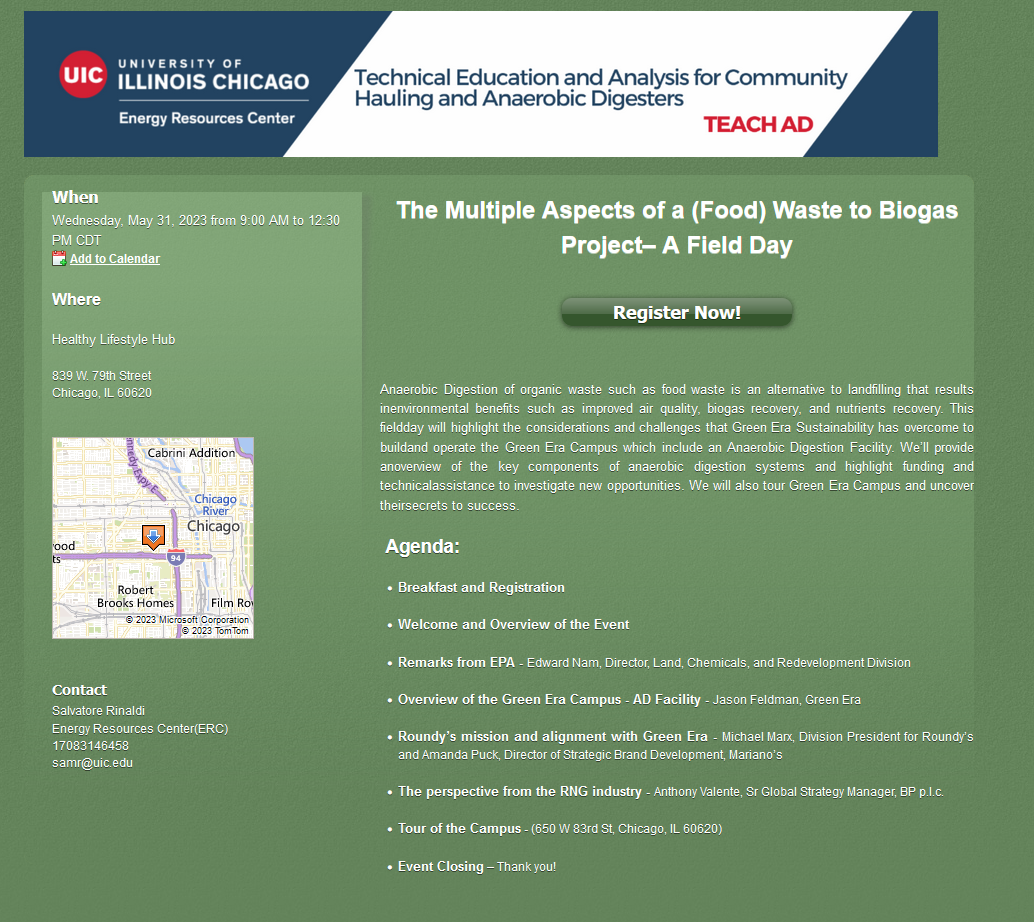
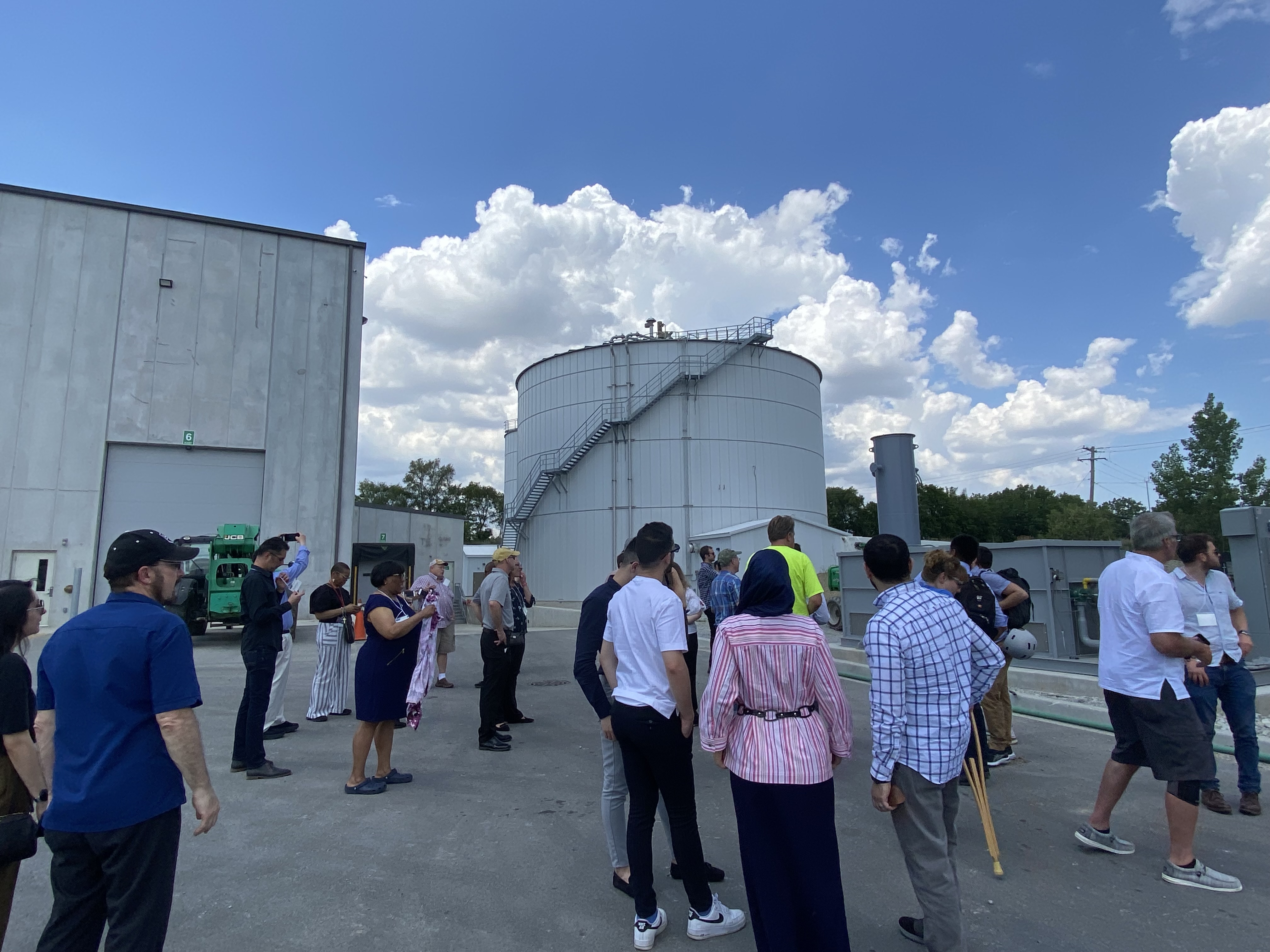
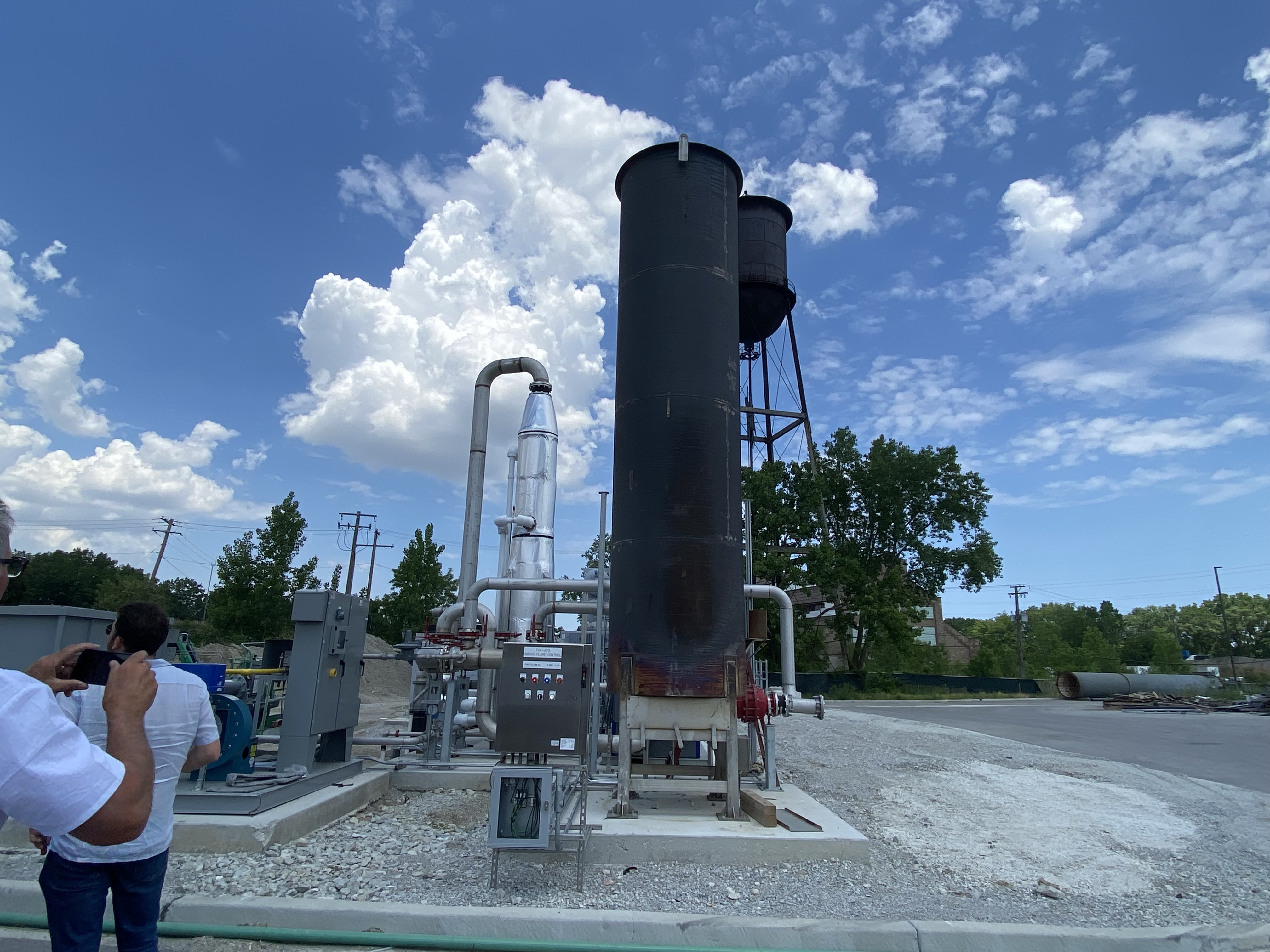
TEACH AD workshop at the Healthy Lifestyle Hub, about the anaerobic digesters installed at Green Era Campus
Associated Project(s):
Attached Files:

From: Leciejewski, Mary <leciejewski.8@osu.edu>
Sent: Wednesday, May 3, 2023 7:37 AM
To: B10andFriends@umich.edu
Subject: Waste Affinity Survey & Meeting
Morning Big 10 and Friends,
Hope everyone everyone’s semester is wrapping up nicely. A big thank you goes out to everyone who participated in the Waste Survey [redacted] so far. We’ve already found the excel tool has been helpful in considering new initiatives. If you haven't had the chance to add your school's information, please do so at your earliest convenience.
If you’re interested in reviewing the waste results together, fill out this When2Meet [redacted] by Wednesday, May 10th.
Looking forward to catching up and discussing the findings with all of you!
Mary, Tony, and the survey subgroup
Mary Leciejewski, MS
Zero Waste Manager
Pronouns: She/Her/Hers
Facilities Operations and Development, Sustainability & Strategic Services
1130 Service Building Annex | 2578 Kenny Road, Columbus, OH 43210
(O) 614.292.3637
fod.osu.edu/sustainability
From: Leciejewski, Mary <leciejewski.8@osu.edu>
Sent: Wednesday, May 3, 2023 6:52 AM
To: Szal, Dominika Patrycja <dszal2@illinois.edu>; Patrick T Brown <brown471@purdue.edu>; Anthony Gillund <agillund@purdue.edu>; Hulse, Daphne Lauren <dlhulse2@illinois.edu>; alisonlr@umich.edu; nberg@umich.edu
Subject: RE: Purdue/OSU/Michigan/UIUC Waste Survey
Hi Dominika,
Thanks for the nudge. I just had an email exchange with Tony, and we've decided to send out an email to find a time to review results, as well as to encourage everyone who hasn’t yet to complete the survey. We'll have to work with the responses we get, and I know our group has already found the results useful. This is a good litmus test for gauging people's availability for benchmarking surveys in the future.
Hope everyone is making it through the tsunami that is move-out! I am continually shocked at the amount of material going to waste this time of year.
Mary Leciejewski, MS
Zero Waste Manager
Pronouns: She/Her/Hers
Facilities Operations and Development, Sustainability & Strategic Services
1130 Service Building Annex | 2578 Kenny Road, Columbus, OH 43210
(O) 614.292.3637
fod.osu.edu/sustainability
From: Szal, Dominika Patrycja <dszal2@illinois.edu>
Sent: Friday, April 28, 2023 1:09 PM
To: Leciejewski, Mary <leciejewski.8@osu.edu>; Patrick T Brown <brown471@purdue.edu>; Anthony Gillund <agillund@purdue.edu>; Hulse, Daphne Lauren <dlhulse2@illinois.edu>; alisonlr@umich.edu; nberg@umich.edu
Subject: Re: Purdue/OSU/Michigan/UIUC Waste Survey
Hello all,
Just to briefly reintroduce myself, I am an intern working with Daphne on this waste management survey. I'd like to thank you all for the contributions that you have made for this initiative; it has been very exciting witnessing the collaboration and ideas that have been taking place. Given that we have some responses, do you believe that we have enough information to move forward to the analysis phase of the project? As of today, we are still awaiting responses from nine universities for the general questions and fourteen universities for their diversion rate methodologies.
Thank you,
DOMINIKA P. SZAL (she/her)
Waste Management Intern
(217) 333-9191 | dszal2@illinois.edu
Facilities & Services | University of Illinois at Urbana-Champaign

Please consider the environment before printing out an email. Under the Illinois Freedom of Information Act any written communication to or from university employees regarding university business is a public record and may be subject to public disclosure.
From: Leciejewski, Mary <leciejewski.8@osu.edu>
Sent: Tuesday, January 31, 2023 06:09
To: Patrick T Brown <brown471@purdue.edu>; Anthony Gillund <agillund@purdue.edu>; Hulse, Daphne Lauren <dlhulse2@illinois.edu>; alisonlr@umich.edu <alisonlr@umich.edu>; nberg@umich.edu <nberg@umich.edu>
Cc: Szal, Dominika Patrycja <dszal2@illinois.edu>
Subject: RE: Purdue/OSU/Michigan/UIUC Waste Survey
Thanks everyone for your feedback. I will get the survey out later today! Mary
Mary Leciejewski
Zero Waste Manager
Pronouns: She/Her/Hers
Facilities Operations and Development, Sustainability & Strategic Services
1130 Service Building Annex | 2578 Kenny Road, Columbus, OH 43210
(O) 614.292.3637
fod.osu.edu/sustainability
From: Patrick T Brown <brown471@purdue.edu>
Sent: Wednesday, January 25, 2023 1:44 PM
To: Anthony Gillund <agillund@purdue.edu>; Leciejewski, Mary <leciejewski.8@osu.edu>; Hulse, Daphne Lauren <dlhulse2@illinois.edu>; alisonlr@umich.edu; nberg@umich.edu
Cc: Szal, Dominika Patrycja <dszal2@illinois.edu>
Subject: RE: Purdue/OSU/Michigan/UIUC Waste Survey
Hi, all. I added a few clarifying comments to the Diversion Rate Methodology sheet. The comments are on cells: Precious Metals, Yard Waste, Recycled Batteries, Recycled Vehicles, and Surplus Donate Items. I also added a few more streams we
Hi, all.
I added a few clarifying comments to the Diversion Rate Methodology sheet. The comments are on cells: Precious Metals, Yard Waste, Recycled Batteries, Recycled Vehicles, and Surplus Donate Items.
I also added a few more streams we track that were not on the list. Those cells are filled with yellow. Feel free to remove if they don’t make sense. For the added Surplus Sold Items stream, it will be dependent on the answer to the comment on Surplus Donated Items.
Thank you!
Patrick T. Brown | He/Him
Sustainability Coordinator | Campus Planning, Architecture and Sustainability
m: 219-677-6330
Website, Facebook, Twitter, Instagram

From: Anthony Gillund <agillund@purdue.edu>
Sent: Wednesday, January 25, 2023 9:38 AM
To: Leciejewski, Mary <leciejewski.8@osu.edu>; Hulse, Daphne Lauren <dlhulse2@illinois.edu>; alisonlr@umich.edu; nberg@umich.edu; Patrick T Brown <brown471@purdue.edu>
Cc: Szal, Dominika Patrycja <dszal2@illinois.edu>
Subject: RE: Purdue/OSU/Michigan/UIUC Waste Survey
Thanks Daphne. Mary actually made that draft (thank you Mary!) and Patrick and I had a few minor edits to add. Hopefully that can be completed today or tomorrow and back to you for review. We will definitely include the idea of the “other – list please” being added.
Thanks again,
Tony
From: Leciejewski, Mary <leciejewski.8@osu.edu>
Sent: Tuesday, January 24, 2023 8:10 PM
To: Hulse, Daphne Lauren <dlhulse2@illinois.edu>; Anthony Gillund <agillund@purdue.edu>; alisonlr@umich.edu; nberg@umich.edu; Patrick T Brown <brown471@purdue.edu>
Cc: Szal, Dominika Patrycja <dszal2@illinois.edu>
Subject: RE: Purdue/OSU/Michigan/UIUC Waste Survey
|
---- External Email: Use caution with attachments, links, or sharing data ---- |
Thanks for the feedback, Daphne.
Once we have the go-ahead from Tony, I will send to the larger affinity group.
Excited to see all the results!
Mary
Mary Leciejewski
Zero Waste Manager
Pronouns: She/Her/Hers
Facilities Operations and Development, Sustainability & Strategic Services
1130 Service Building Annex | 2578 Kenny Road, Columbus, OH 43210
(O) 614.292.3637
fod.osu.edu/sustainability
From: Hulse, Daphne Lauren <dlhulse2@illinois.edu>
Sent: Tuesday, January 24, 2023 4:33 PM
To: Anthony Gillund <agillund@purdue.edu>; Leciejewski, Mary <leciejewski.8@osu.edu>; alisonlr@umich.edu; nberg@umich.edu; Patrick T Brown <brown471@purdue.edu>
Cc: Szal, Dominika Patrycja <dszal2@illinois.edu>
Subject: RE: Purdue/OSU/Michigan/UIUC Waste Survey
Hi Tony, I took a look at the new tab for diversion materials and think it looks great. There was a comment made asking about what to do if a school has a material they include in the rate that isn’t listed on the sheet, so I added a “Other
Hi Tony,
I took a look at the new tab for diversion materials and think it looks great. There was a comment made asking about what to do if a school has a material they include in the rate that isn’t listed on the sheet, so I added a “Other – please list” column for that purpose.
Otherwise, I am happy with the survey and would call it good! Thanks so much for the assistance.
Thank you,
Daphne
Daphne Hulse (she/her)
Zero Waste Coordinator
Facilities & Services | University of Illinois Urbana-Champaign
+1 (217) 333-7550 | dlhulse2@illinois.edu
Please consider the environment before printing an email. Under the Illinois Freedom of Information Act any written communication to or from university employees regarding university business is a public record and may be subject to public disclosure.
From: Anthony Gillund <agillund@purdue.edu>
Sent: Tuesday, January 17, 2023 8:05 AM
To: Hulse, Daphne Lauren <dlhulse2@illinois.edu>; Leciejewski, Mary <leciejewski.8@osu.edu>; alisonlr@umich.edu; nberg@umich.edu; Patrick T Brown <brown471@purdue.edu>
Cc: Szal, Dominika Patrycja <dszal2@illinois.edu>
Subject: RE: Purdue/OSU/Michigan/UIUC Waste Survey
Thanks Daphne. We will get back to you ASAP!
From: Hulse, Daphne Lauren <dlhulse2@illinois.edu>
Sent: Friday, January 13, 2023 10:19 AM
To: Anthony Gillund <agillund@purdue.edu>; Leciejewski, Mary <leciejewski.8@osu.edu>; alisonlr@umich.edu; nberg@umich.edu; Patrick T Brown <brown471@purdue.edu>
Cc: Szal, Dominika Patrycja <dszal2@illinois.edu>
Subject: RE: Purdue/OSU/Michigan/UIUC Waste Survey
|
---- External Email: Use caution with attachments, links, or sharing data ---- |
Hi Tony,
Thanks for the update! We are appreciative of the feedback you and OSU have provided and are happy to incorporate it. I think the suggestion to add a tab for diversion rate materials is a great one, and we would appreciate your help with integrating it into the survey!
Thank you,
Daphne
From: Anthony Gillund <agillund@purdue.edu>
Sent: Thursday, January 12, 2023 12:55 PM
To: Leciejewski, Mary <leciejewski.8@osu.edu>; Hulse, Daphne Lauren <dlhulse2@illinois.edu>; alisonlr@umich.edu; nberg@umich.edu; Patrick T Brown <brown471@purdue.edu>
Cc: Szal, Dominika Patrycja <dszal2@illinois.edu>
Subject: RE: Purdue/OSU/Michigan/UIUC Waste Survey
Hi Daphne, Mary and I met to discuss the Waste Affinity Group topics and we are hoping to be able to focus in on the survey you have developed. Once the document is ready to share, we are happy to help send it to the group, and then we can remind folks to complete it at the February BTAF Meeting (exact date TBD). We are anticipating not having a Waste Affinity Meeting prior to the full BTAF Meeting in February, but if this group needs to get together, just let me know and I would be happy to schedule.
In terms of finishing the survey, it appears that you have largely incorporated all the recommendations, thank you! There is one modification that I wanted to validate with you that our group has offered to make: a separate tab in the same spreadsheet where the answers for cell AH Materials included in your diversion rate can be put into its own grid and easier to compare school to school. If you are good with this idea, we will try to complete this next week and send it back.
Thank you,
Tony
From: Anthony Gillund
Sent: Friday, January 6, 2023 12:42 PM
To: Leciejewski, Mary <leciejewski.8@osu.edu>; Hulse, Daphne Lauren <dlhulse2@illinois.edu>; alisonlr@umich.edu; nberg@umich.edu; Patrick T Brown <brown471@purdue.edu>
Cc: Szal, Dominika Patrycja <dszal2@illinois.edu>
Subject: RE: Purdue/OSU/Michigan/UIUC Waste Survey
Hi Daphne, we just had a meeting today with our local waste district and one of the questions that came up is if there are institutions that have found methods to eliminate the plastic bags from the recycling stream. I thought some institutions do this (e.g. breaking bags of recycling into the recycling dumpster but tossing the bag into the trash). If you think it is beneficial, perhaps this is another item to add to the survey.
Thanks again,
Tony
From: Anthony Gillund
Sent: Friday, January 6, 2023 8:51 AM
To: Leciejewski, Mary <leciejewski.8@osu.edu>; Hulse, Daphne Lauren <dlhulse2@illinois.edu>; alisonlr@umich.edu; nberg@umich.edu; Patrick T Brown <brown471@purdue.edu>
Cc: Szal, Dominika Patrycja <dszal2@illinois.edu>
Subject: RE: Purdue/OSU/Michigan/UIUC Waste Survey
Hi Daphne, great survey and I agree with Mary it is very comprehensive! Patrick and I reviewed the document we came up with a few recommendations for your consideration:
Thank you again for putting this together. Looking forward to seeing it once it is all filled out!
Thanks,
Tony Gillund
Director of Sustainability
Campus Planning, Architecture, and Sustainability
o: 765-494-3911 | agillund@purdue.edu

From: Leciejewski, Mary <leciejewski.8@osu.edu>
Sent: Wednesday, January 4, 2023 8:26 AM
To: Hulse, Daphne Lauren <dlhulse2@illinois.edu>; alisonlr@umich.edu; Anthony Gillund <agillund@purdue.edu>; nberg@umich.edu; Patrick T Brown <brown471@purdue.edu>
Cc: Szal, Dominika Patrycja <dszal2@illinois.edu>
Subject: RE: Purdue/OSU/Michigan/UIUC Waste Survey
|
---- External Email: Use caution with attachments, links, or sharing data ---- |
Daphne,
Thanks for reopening the conversation and putting this together. This survey looks comprehensive. We’re excited for the results!
Here’s our quick feedback:
We can make these edits directly in the survey but didn’t want to make changes without giving you a heads up/getting sign off from the group.
Once the other folks on the chain provide feedback, we can help disseminate to the larger BTAF group. When the results are in, it’d be a perfect intern project to assemble results in a slide show and do some data visualization. Happy to donate our intern time towards that task.
Best, Mary
Mary Leciejewski
Zero Waste Manager
Pronouns: She/Her/Hers
Facilities Operations and Development, Sustainability & Strategic Services
1130 Service Building Annex | 2578 Kenny Road, Columbus, OH 43210
(O) 614.292.3637
fod.osu.edu/sustainability
From: Hulse, Daphne Lauren <dlhulse2@illinois.edu>
Sent: Tuesday, January 3, 2023 5:07 PM
To: Leciejewski, Mary <leciejewski.8@osu.edu>; alisonlr@umich.edu; agillund@purdue.edu; nberg@umich.edu; Patrick T Brown <brown471@purdue.edu>
Cc: Szal, Dominika Patrycja <dszal2@illinois.edu>
Subject: RE: Purdue/OSU/Michigan/UIUC Waste Survey
Hi all, Happy New Year - I hope you enjoyed a nice holiday break! Dominika and I wanted to re-open the conversation on the BTAF waste survey. The questions are ready for your review/input when you have a chance J Mary & Tony, we are happy
Hi all,
Happy New Year - I hope you enjoyed a nice holiday break! Dominika and I wanted to re-open the conversation on the BTAF waste survey [redacted]. The questions are ready for your review/input when you have a chance J
Mary & Tony, we are happy to coordinate with you both on getting this spreadsheet out to the schools when everything is finalized.
Thank you,
Daphne
Daphne Hulse (she/her)
Zero Waste Coordinator
Facilities & Services | University of Illinois at Urbana-Champaign
+1 (217) 333-7550 | dlhulse2@illinois.edu
Please consider the environment before printing an email. Under the Illinois Freedom of Information Act any written communication to or from university employees regarding university business is a public record and may be subject to public disclosure.
From: Hulse, Daphne Lauren
Sent: Tuesday, November 29, 2022 9:43 AM
To: Leciejewski, Mary <leciejewski.8@osu.edu>; alisonlr@umich.edu; agillund@purdue.edu; nberg@umich.edu; Patrick T Brown <brown471@purdue.edu>
Cc: Szal, Dominika Patrycja <dszal2@illinois.edu>
Subject: RE: Purdue/OSU/Michigan/UIUC Waste Survey
Thank you, Mary! We’ve got all our original survey questions inputted now and are working to finalize questions on other topics such as sustainable procurement and organic waste, which we didn’t previously include.
If you all have an opportunity to take a look and provide feedback, that would be appreciated!
Thank you,
Daphne
Daphne Hulse (she/her)
Zero Waste Coordinator
Facilities & Services | University of Illinois at Urbana-Champaign
+1 (217) 333-7550 | dlhulse2@illinois.edu
Please consider the environment before printing an email. Under the Illinois Freedom of Information Act any written communication to or from university employees regarding university business is a public record and may be subject to public disclosure.
From: Leciejewski, Mary <leciejewski.8@osu.edu>
Sent: Tuesday, November 29, 2022 8:12 AM
To: Hulse, Daphne Lauren <dlhulse2@illinois.edu>; alisonlr@umich.edu; agillund@purdue.edu; nberg@umich.edu; Patrick T Brown <brown471@purdue.edu>
Cc: Szal, Dominika Patrycja <dszal2@illinois.edu>
Subject: RE: Purdue/OSU/Michigan/UIUC Waste Survey
Hi everyone,
Hope everyone had a nice holiday.
Just want to give a shout out to Daphne and her team for uploading the survey onto the google drive in a spreadsheet format. The benchmarking tool is looking pretty robust. If you haven’t had a chance to check out the google drive, here’s the link [redacted].
Aside from adding additional relevant survey fields and filling in our school’s data, is there anything else we need to do to provide feedback before we take this to the larger BTAF group?
Thanks, Mary
Mary Leciejewski
Zero Waste Manager
Pronouns: She/Her/Hers
Facilities Operations and Development, Sustainability & Strategic Services
1130 Service Building Annex | 2578 Kenny Road, Columbus, OH 43210
(O) 614.292.3637
fod.osu.edu/sustainability
-----Original Appointment-----
From: Hulse, Daphne Lauren <dlhulse2@illinois.edu>
Sent: Wednesday, October 26, 2022 3:15 PM
To: Hulse, Daphne Lauren; alisonlr@umich.edu; Leciejewski, Mary; agillund@purdue.edu; nberg@umich.edu; Patrick T Brown
Cc: Szal, Dominika Patrycja
Subject: Purdue/OSU/Michigan/UIUC Waste Survey
When: Friday, November 11, 2022 11:00 AM-12:00 PM (UTC-06:00) Central Time (US & Canada).
Where: https://illinois.zoom.us/j/83465397844?pwd=K0dHcWlkaXExOTQyUDdrN3J6VXhVUT09
Daphne Hulse (she/her) is inviting you to a scheduled Zoom meeting. Join Zoom Meeting https: //illinois. zoom. us/j/83465397844?pwd=K0dHcWlkaXExOTQyUDdrN3J6VXhVUT09 Meeting ID: 834 6539 7844 Password: 337564
Daphne Hulse (she/her) is inviting you to a scheduled Zoom meeting.
Join Zoom Meeting